Among Philippe’s countless contributions are the Trifari Crown pins from the late 1930s to the 1950s.
The crowns were so popular that Trifari incorporated a crown into its
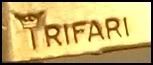
mark in about 1937. Authentic Trifari jewelry is typically marked with
"Jewels by Trifari," "TKF" (for Trifari, Krussman & Fishel), or
"Trifari," depending on when it was made.
Some of the Trifari Crown pins feature eye-catching, brightly colored cabochons. Others are composed entirely of clear crystal rhinestones
for a monochromatic effect. Naturally, a series of Coronation Gems was
produced in 1953 to celebrate the ascendancy of Elizabeth II to the
British throne.
Trifari’s Jelly Belly pins of seals, poodles, roosters, and other animals appeared in the 1940s. Each animal’s "belly" consists of a solid Lucite "pearl" with settings of sterling silver or gold plate. Although any Jelly Belly from this decade is going to command a good price, the poodles are especially rare.
Other categories of vintage Trifari costume jewelry
to look for are the vintage floral pins from the 1930s and the fruit
and vegetable pieces from the 1950s. In particular, collectors like the
miniature fruit pins (apples, pineapples, grape bunches, and
strawberries, to name a few) from the late 1950s through the 1960s.
These single pieces, usually finished in a matte silver or gold, were
worn by themselves or in groups. Also popular are the patriotic pins
from the 1940s of American flags and red-white-and-blue eagles.
Like all manufacturers during World War II, Trifari was unable to use
metal in its products due to rationing. This forced Trifari to switch to
sterling silver
during the war, which tripled prices for Trifari products (although
that didn’t seem to hurt sales). Post-war, Trifari wanted to go back to
less costly, maintenance-free metal, but its audience was now used to
silver. To hype the return to a cheaper base metal, the company began
advertising a "revolutionary" new metal called Trifanium, which was a
made-up name for their basic metal — unlike silver, it could be given a
no-polish rhodium finish.
The campaign worked so well that by 1953, Mamie Eisenhower felt perfectly comfortable to break with tradition and wear costume jewelry to the inaugural ball. To match the First Lady’s pink satin gown (studded with 2,000 rhinestones), Alfred Philippe designed an "orientique" pearl choker with matching three-stranded bracelet and earrings,
each laden with eight pearls. Three sets were made: one for the First
Lady, a second for the Smithsonian, and a third for the Trifari
archives. Mrs. Eisenhower was so pleased with the ensemble that she had
Trifari make jewelry for her second inaugural ball in 1957.
Key terms for Vintage Trifari Costume Jewelry
Cabochon: A stone that has been shaped and polished instead of faceted. It usually has a flat back and a shape that is round or oval.
The Trifari Mark
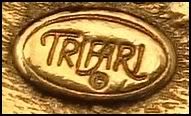
Seeing the mark is important for a collector, as it helps to date the piece. Here are pictures of the Trifari Mark over time:
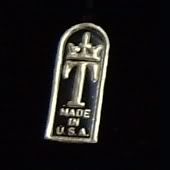
The Trifari Crown Symbol
Trifari used a Crown Symbol over the "T" as a type of logo. It appeared on boxes, tags, and cards and was stamped onto most of the pieces produced from the 1940's through the 1960's. Usually all pieces of a set included the crown, with the exception of necklaces with hook clasps - often there was only room for the name "Trifari" on the hook. When sellers identify a pieces a "Crown Trifari" it means the piece was stamped with this symbol (see photos of Trifari paper tag and stamped clasp below).
Trifari PAT. PEND.
This is one of the earliest Trifari marks you will see (there were a couple of earlier signatures, but they are quite rare). Prior to 1955 the U.S. copyright law did not extend protection to jewelry designs, so the major manufacturers, who employed talented jewelry designers, protected their investment with U.S. patents. As soon as a design was completed, it was submitted to the U.S. patent office and a patent was applied for. This process normally took a few months, so the jewelry would be stamped PAT. PEND. to advise that a patent application for the design was filed (see photo below).
The photo above shows an early Trifari PAT. PEND. signature. Many of these signatures also included the Trifari Crown symbol over the "T."
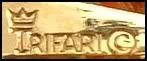
Crown Trifari with Copyright Symbol
As mentioned previously, in 1955 revisions to the U.S. Patent Law allowed jewelry designs to be copyrighted using the copyright symbol. Trifari then started using the copyright symbol in its signature. Pieces of that era will have both the Crown and Copyright symbols in the signature, which was used in the late 1950's to late 1960's. The photos below show a Trifari Crown signature with the copyright symbol. Many of the most highly sought after vintage Trifari pieces have this signature (see photo below). They are called "CROWN TRIFARI" by dealers and collectors.
Note that the lack of a copyright symbol on a piece does not guarantee that was produced prior to1955. At the time of the copyright law change Trifari had a number of necklace, bracelet, and earring clasps that it continued to use for several years until the stock of these ran out. As a general rule, however, at least one piece of a set would include the copyright symbol.
Trifari with Copyright Symbol (no Crown)
In the 1970's and 1980's Trifari changed their signature by removing the crown symbol and switching to a slanted text. The copyright symbol was retained to protect the designs. The photo below shows the signature used during this era.
Mixed Trifari Marks
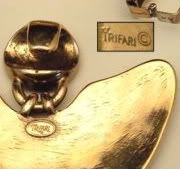
As mentioned, Trifari, like many other jewelry manufacturers, would continue to use its stock of clasps after signatures were changed, so it's not uncommon to see pieces with mixed signatures. For example, in the 1970's and 1980's Trifari made quite a few earring designs that were available as both clips and as posts for pierced ears. Clip earrings made during that time period may be stamped on the back with the 1970's-1980's Trifari Copyright signature, like the post versions were, but the clips might have the Crown Trifari signature, since Trifari would continue to use the older clasps until they were used up. Trifari would also use up the old necklace and bracelet clasps, so was not uncommon to see the Crown Trifari signature on the clasp, while the piece itself was stamped with the later Trifari Copyright, as in the photo below. This photo shows the back of a Trifari pendant necklace, where the pendant is signed with the Trifari Copyright signature, while the clasp is stamped Crown Trifari.

Trifari TM, Trifari TM Dated, Trifari TM Limited Editions
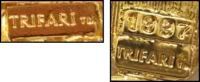
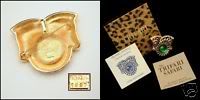
In the 1990's Trifari offered many high quality pieces for sale on QVC. Many of these used original Trifari designs from the 1940's and 1950's. Technically, vintage items are those that are 25 years old or older, but many collectors include Trifari TM pieces because they are the last of the signed Trifari pieces, with high quality and stunning designs. Pieces of this era were signed "TRIFARI" followed by the trademark symbol. Some were dated, and some were dated and also Limited Editions. The Limited Editions were packaged with a special card that indicated how many copies of the piece were made (usually 350 or 500). It's rare to find one with its original box and card. The Trifari Safari Series was a very popular Limited Edition line with jungle animals. The photos below show a Trifari trademark signature, a Trifari trademark signature with a date, and a Trifari Safari Piece, with its original box and Limited Edition card.


(Information and image sources: Collector's Weekly and eBay Guides)